There is a particular kind of tiredness that comes from a life made mostly of obligations. You wake up, you answer messages, you work, you run errands, you tidy up, you scroll, you sleep, and then you do it all again. Somewhere in that rhythm, the part of you that once made things just for the fun of it got quietly pushed to the back of a drawer. If that sounds familiar, you are not alone — and the good news is that reclaiming that part of yourself does not require a studio, a degree, or a week off work. It requires a small corner of your home, a little curiosity, and permission to be a beginner.
Creative hobbies for adults at home have become something of a quiet movement. People are knitting on the couch during conference calls, painting in the twenty minutes before dinner, and pressing flowers between the pages of books they meant to read. The appeal is not productivity. It is the opposite, really: the chance to make something that has no deadline, no client, and no performance review. What follows is a long, practical, gently encouraging guide to the best creative hobbies you can start at home — plus how to actually stick with one, how to set up a space that invites you in, and how to stop perfectionism from stealing the joy before it begins.
Why Creative Hobbies Matter More Than You Think
Adults often treat hobbies as a luxury, something to get to “once things calm down.” But the research and the lived experience of millions of people suggest otherwise. Engaging in creative activity lowers stress hormones, improves mood, and gives your brain a break from the kind of linear, problem-solving thinking that dominates most workdays. When you paint, knit, or shape clay, you enter a state that psychologists sometimes call “flow” — a stretch of time where you are so absorbed in what you are doing that self-consciousness and worry temporarily disappear.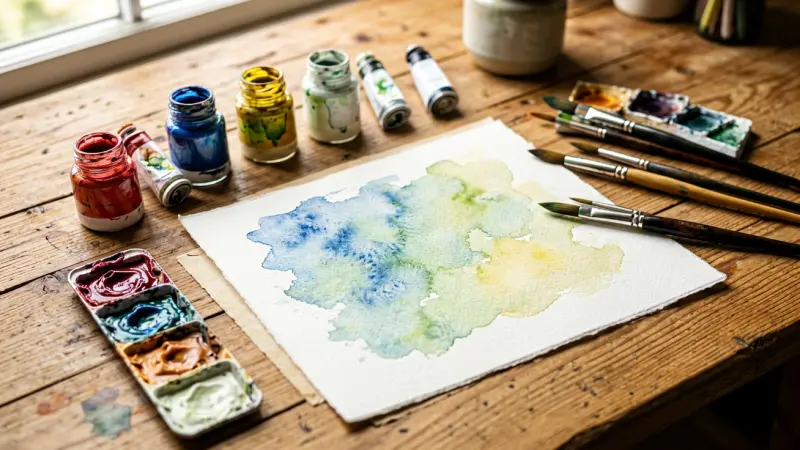
There is also the matter of identity. Many adults describe feeling like they are only their job title or their role in the family. A creative hobby gives you a different answer to the question “what do you do?” You are a person who makes candles. You are a person who draws. You are a person who is learning the ukulele. That small shift in self-description can be surprisingly powerful.
And then there is the sheer pleasure of tangible progress. In a world of endless email threads and unfinished projects, finishing a scarf, a sketchbook page, or a batch of soap gives you something rare: a clear beginning, middle, and end.
How to Choose the Right Creative Hobby for You
Before you scroll down and feel overwhelmed by options, it helps to narrow the field with a few honest questions.
- Do you want to make something with your hands or with your mind? Hands-on hobbies like pottery and embroidery offer a physical, tactile satisfaction. Mind-forward hobbies like writing and songwriting scratch a different itch.
- How much space do you actually have? A tiny apartment still has room for watercolor, hand lettering, or knitting. Resin, pottery, and woodworking need more ventilation and surface area.
- How much setup and cleanup can you tolerate? If you know you will not clean brushes at 10 p.m., choose something that starts and stops easily.
- Do you want to be alone or with others? Some hobbies are naturally solitary; others, like a virtual knitting circle or an online writing group, come with built-in community.
- What did you love as a child? The things you loved before you learned to be self-conscious are often the best clues.
Give yourself permission to try three or four things before committing. Sampling is not flakiness; it is research.
1. Watercolor Painting
Watercolor is one of the most forgiving and accessible creative hobbies for adults at home. A basic set of pans, a couple of brushes, and a pad of cold-press paper will cost less than a dinner out, and the whole kit fits in a shoebox. It is also wonderfully unpredictable, which is part of its charm. You learn to work with the water rather than against it, to let blooms happen, and to accept that a painting can go somewhere you did not plan.
Start with simple subjects: a single leaf, a mug, a wash of sky. Do not aim for a masterpiece. Aim for the pleasure of watching pigment move across wet paper. Many people find that watercolor becomes a form of meditation, a way to end the day with color instead of screens.
2. Drawing and Sketching
Drawing is the foundation skill that quietly improves everything else you make. It also has the lowest barrier to entry of almost any creative pursuit: a pencil and any piece of paper will do. The trick is to reframe what drawing is for. It is not a test of talent. It is a way of looking more closely at the world.
Try a daily five-minute sketch of something on your desk. Try contour drawing, where you draw the outline of your own hand without looking at the page. Try copying a photograph you love. Over weeks, you will notice your eye getting sharper, and that sharpened attention spills into the rest of your life.
3. Hand Lettering and Calligraphy
Hand lettering is having a moment, and for good reason. It is inexpensive, portable, and endlessly satisfying. A set of brush pens and a dotted notebook are enough to begin. You can letter quotes, make cards, design wall art, or simply practice the alphabet until your strokes become confident and rhythmic.
Calligraphy, with its dip pens and ink, is a slower and more traditional cousin. Both disciplines reward patience and repetition. They are ideal hobbies for people who like the idea of measurable improvement — you can literally see your letters get better week by week.
4. Creative Writing and Journaling
You do not need to be writing a novel to be a writer. Journaling, poetry, short stories, essays, and even letter writing all count. Creative writing at home requires nothing but a notebook or a blank document and a willingness to produce bad first drafts. The point is to get words out of your head and onto the page, where they can surprise you.
If you want structure, try morning pages — three longhand pages written first thing, with no editing. If you want prompts, there are thousands available online. If you want to go deeper into reflective practice and self-development through reading and writing, a good reading list can be a wonderful companion; resources like these best books for personal growth can fuel both your journaling and your creative thinking.
5. Knitting and Crochet
Knitting and crochet are the classic couch hobbies, and they deserve their reputation. They are portable, repetitive in a soothing way, and they produce something useful. A scarf, a hat, a blanket, a set of coasters — every project is a small, wearable proof that you made something with your own two hands.
Start with a chunky yarn and a large hook or needle; thicker materials are easier to see and more forgiving of uneven tension. There are excellent free tutorials for every skill level. Many people find that once they learn the basic stitches, the rhythm becomes almost hypnotic, and it is one of the few hobbies you can genuinely do while listening to a podcast or watching a show.
6. Embroidery and Cross-Stitch
Embroidery is drawing with thread, and it has a low-key, vintage charm that has drawn in a whole new generation of makers. A hoop, a few needles, some floss, and a piece of cotton fabric are all you need. You can embroider flowers, words, tiny portraits of your pets, or abstract patterns.
Cross-stitch is the more structured sibling, following a grid pattern stitch by stitch. Both are wonderfully meditative and produce frameable results. If you share your home with a cat, be warned: embroidery thread is apparently the most fascinating toy ever invented. It is the kind of chaos that makes a house feel lived in — much like the feelings explored in pieces about how loving a pet so much it hurts.
7. Pottery and Air-Dry Clay
There is something primal about working with clay. If you do not have access to a kiln, air-dry clay is a fantastic alternative. You can make small bowls, ring dishes, planters, beads, and sculptural objects, then paint or seal them once dry.
Working with clay engages your hands and your imagination at the same time. It is also wonderfully forgiving — if you do not like what you made, you can squash it and start again. Set up a washable tablecloth, keep a bowl of water nearby, and let yourself get a little messy.
8. Candle Making
Candle making is one of those hobbies that feels luxurious and turns out to be surprisingly straightforward. Soy wax, wicks, fragrance oils, and a few heat-safe containers are the core supplies. You melt, you pour, you wait, and you have candles that smell exactly how you want them to.
It is a great hobby for people who love scent and atmosphere, and it makes beautiful gifts. Do your homework on safety — proper wick sizing and temperature matter — and always work in a well-ventilated space.
9. Soap Making
Handmade soap is another craft that sits at the intersection of useful and beautiful. Melt-and-pour soap is the beginner-friendly route and requires no lye handling. Cold-process soap is more advanced and more rewarding, producing a genuinely artisanal bar.
You can experiment with colors, exfoliants, botanicals, and essential oils. The learning curve is real but manageable, and the results are the kind of thing people happily display in their bathrooms.
10. Resin Art
Resin has become one of the most visually striking creative hobbies around. You can pour it into molds to make jewelry and coasters, or use it to create abstract paintings with swirling pigments and gold flakes. The glossy, glass-like finish makes even simple projects look professional.
Resin does require care: work in a ventilated area, wear gloves and a mask, and follow the manufacturer’s ratios carefully. But for makers who love bold color and shine, it is addictive.
11. Photography
You already own a camera — it is in your pocket. Photography as a hobby is about learning to see: light, composition, texture, and moment. You can photograph the same windowsill every morning for a month and learn more about light than any course could teach you.
If you travel, photography becomes a natural companion. Even a solo trip can be transformed into a creative project, an idea explored thoughtfully in guides like this one on how to travel solo as a female. At home, try a weekly photo walk around your own neighborhood. You will be amazed at what you notice when you are looking for it.
12. Playing an Instrument
Learning an instrument as an adult is intimidating and, at the same time, one of the most rewarding things you can do. You do not need to aim for concert level. Learning four chords on a ukulele, a few songs on a keyboard, or basic fingerpicking on a guitar is enough to bring music into your daily life.
Fifteen minutes a day beats two hours once a week. Apps and online lessons make it easier than ever to learn at your own pace, without the pressure of a recital.
13. Cooking and Baking as Creative Practice
If you already cook, you may not think of it as a hobby. But there is a difference between making dinner and making a project. Baking bread from scratch, fermenting hot sauce, decorating cookies, or learning a new cuisine are all deeply creative acts.
The sensory feedback is immediate: smell, texture, taste. And unlike a painting that hangs on a wall, your creation gets eaten, shared, and enjoyed. Sourdough starters have become a kind of pet for many home bakers — demanding, alive, and oddly affectionate.
14. Gardening and Indoor Plants
Gardening is creativity with a delayed payoff. You plant, you tend, you wait, and eventually something blooms. Even in a small apartment, you can grow herbs on a windowsill, propagate succulents, or build a tiny indoor jungle.
The act of caring for living things is grounding, and the visual results — leaves unfurling, buds opening — provide a steady stream of small delights. If you want a hobby that doubles as self-care, this is a strong candidate.
15. Scrapbooking, Collage, and Junk Journaling
Paper crafts are wonderfully forgiving because there is no wrong answer. Scrapbooking preserves memories. Collage lets you play with color, texture, and image. Junk journaling combines both, turning receipts, tickets, and scraps into a layered, messy, personal artifact.
All you need is paper, glue, and something to cut with. It is an excellent hobby for people who feel blocked by the blank page, because you are assembling rather than inventing from nothing.
16. Digital Creativity
Not every creative hobby has to be physical. Digital illustration, photo editing, video making, beat production, 3D modeling, and game design are all legitimate creative pursuits you can learn entirely at home. Tablets with styluses have made digital drawing more natural than ever.
The advantage is that digital work is easy to store, share, and revise. The disadvantage is that screens can blur the line between work and play, so it helps to treat your creative screen time as a separate, protected ritual.
17. Woodworking and Small DIY Projects
For those with a garage, balcony, or spare corner, woodworking offers a deep, tactile satisfaction. You do not need a full shop to start. A hand saw, a drill, sandpaper, and a few clamps are enough for simple shelves, plant stands, and picture frames.
Building something functional that lives in your home is a particular kind of pride. Measure twice, cut once, and accept that your first project will teach you more than any tutorial.
18. Flower Pressing and Botanical Crafts
Flower pressing is one of the most charming, low-cost hobbies available. You pick flowers, press them between sheets of paper and heavy books, and then use them in cards, framed art, or resin jewelry. It connects you to the seasons and to the small, beautiful things growing outside your door.
It is also a lovely companion to journaling — many people press flowers directly into their notebooks to mark moments in time.
19. Music and Sound as Ambient Creativity
If traditional instruments feel like too much, consider ambient creativity: making playlists, composing simple loops in a free app, recording field sounds, or learning to mix. Sound design is a creative field that rewards curiosity more than formal training.
You might end up with a personal soundtrack for your morning routine, or a small collection of sounds that mean something only to you. Both count.
20. Restoration and Upcycling
Upcycling is creativity with a sustainability bonus. Take something discarded — a chair from the curb, an old frame, a plain t-shirt — and transform it. Paint it, reupholster it, embroider it, turn it into something new.
This hobby sharpens your problem-solving and your design eye, and it is deeply satisfying to look at an object and know you saved it from a landfill.
Building a Space That Invites You to Create
You do not need a dedicated studio. What you need is a spot where your supplies can stay out. A tray that lives on a side table. A basket next to the couch. A drawer you can pull open and close. The single biggest predictor of whether you will actually do your hobby is how many steps it takes to begin.
Good lighting matters more than you think. So does a comfortable chair. So does a surface you are allowed to ruin. If you can, put your supplies somewhere visible. Out of sight really is out of mind, and a basket of yarn on the arm of a chair is a standing invitation.
How to Beat Perfectionism
Perfectionism is the number one killer of adult hobbies. It shows up as “I’m not good at this,” “there’s no point if it’s not good,” and “I’ll start when I have more time.” The antidote is to lower the stakes deliberately.
- Set a practice goal, not a quality goal. “I will paint for twenty minutes” beats “I will paint something good.”
- Make bad work on purpose. Fill a page with terrible drawings. Write a deliberately awful poem. It breaks the spell.
- Keep your early work. Looking back at it in six months is one of the most motivating things you can do.
- Separate making from sharing. You do not have to post everything. Some things can be just for you.
Finding Time When You Have None
Most adults do not have big blocks of free time, and waiting for one is a trap. Instead, use the small pockets. Ten minutes before bed. Twenty minutes on a Sunday morning. The time it takes for pasta to boil. Creative hobbies are surprisingly compatible with a busy life when you stop expecting them to be a whole afternoon.
It also helps to attach your hobby to an existing habit. After coffee, you sketch. After dinner, you knit. Habit stacking works because it removes the decision-making step entirely.
Budgeting for a New Hobby
Hobbies can be expensive, but they do not have to be. Start with the cheapest possible version of the thing you want to try. Buy one brush, not a set. Borrow a guitar. Use the yarn you already have. Once you know you love it, upgrade deliberately.
Buying supplies is often more fun than doing the hobby, which is a trap in itself. If you notice yourself shopping for gear more than making things, that is a sign to pause and use what you have.
Finding Community Without Leaving Home
One of the myths about home hobbies is that they are lonely. In practice, many of them come with thriving online communities: subreddits, Discord servers, virtual knit nights, writing groups, and local classes. Sharing your work-in-progress with even one other person makes a hobby stickier.
You can also go the opposite direction and treat your hobby as sacred solitude — the one part of your life with no audience at all. Both approaches are valid. The important thing is that it belongs to you.
Starting Today, Not Someday
Pick one thing from this list. Not five. One. Buy the smallest possible starter kit, or use what you already have in the house. Set aside twenty minutes this week. Sit down, make something imperfect, and notice how it feels.
Creative hobbies for adults at home are not about becoming an expert. They are about reclaiming a part of yourself that got buried under responsibilities. They are about color, texture, sound, and the quiet pleasure of making something that did not exist before you made it.
Your hands already know how to do this. They have just been waiting for you to ask.