You look up, and there it is: a pale, many-legged shape moving across the ceiling with unsettling speed. House centipedes are one of the most startling things to find above your head, largely because they move differently from anything else in a typical home. They seem to appear out of nowhere, and they vanish just as quickly when you reach for something to swat them with.
Before you panic, it helps to know what you are actually dealing with. This article explains why house centipedes end up on ceilings, whether they pose any real risk to you, and how to reduce their numbers if you would rather not share your home with them.
What You’re Actually Looking At
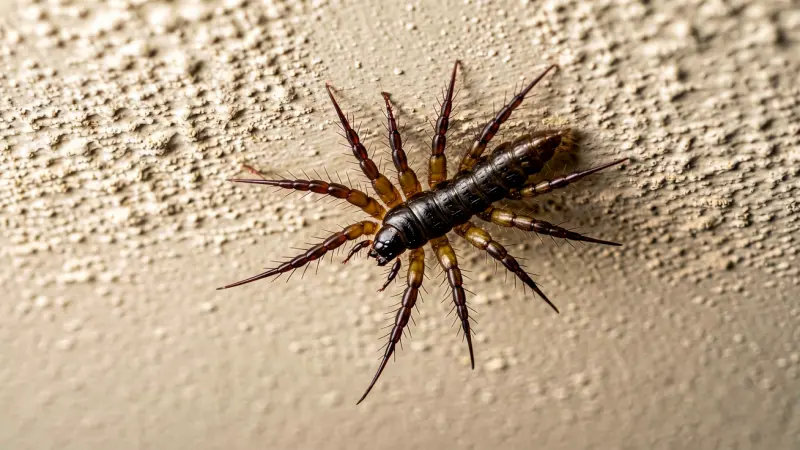
The house centipede, known scientifically as Scutigera coleoptrata, is not an insect at all. It belongs to a separate group of arthropods called centipedes, which are distinguished by having one pair of legs per body segment rather than two. A house centipede has fifteen pairs of legs, and those legs are unusually long relative to its body.
That body is typically yellowish-grey with three dark stripes running lengthwise along its back. Its legs are banded, and its antennae are extremely long and thin. The overall effect is a creature that looks fragile and fast at the same time, which is exactly what it is.
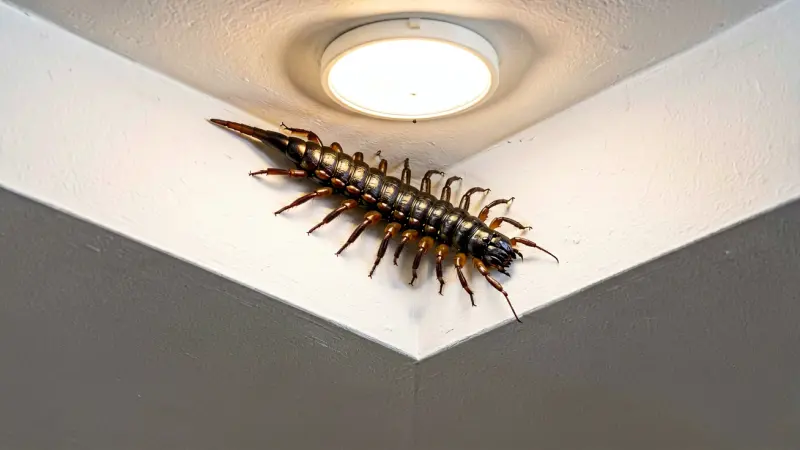
Unlike many of its relatives, the house centipede has evolved to live indoors. It is native to the Mediterranean region but has spread across much of the world, and it is now a common household resident in many temperate climates. It prefers damp, dark spaces, which is why basements, bathrooms, and laundry rooms are frequent hangouts.
Why House Centipedes End Up on Ceilings
The ceiling is not a random destination. House centipedes are active hunters, and they go where their prey goes.
They Are Following Food
House centipedes eat other arthropods. Their diet includes cockroaches, silverfish, spiders, ants, bed bugs, termites, and carpet beetles. If any of those are present in your home, the centipedes will seek them out wherever they are, including on walls and ceilings.
Ceilings are often where spiders build webs and where silverfish and other small insects travel. A centipede on the ceiling is usually a centipede that has found a hunting ground.
They Can Climb Almost Anything
The house centipede’s legs are adapted for climbing. Each leg ends in a structure that helps it grip smooth surfaces, which means it can move easily across painted walls, tiles, and plaster ceilings. It can also hang upside down without difficulty.
This climbing ability is part of what makes them so startling. Most household pests stay near the floor or in cupboards. A centipede that can traverse the ceiling opens up a much larger territory.
They Are Nocturnal
House centipedes are most active at night. They emerge from hiding places to hunt, and they are far more likely to be seen after dark than during the day. If you spot one on the ceiling in the evening, you are seeing normal behaviour rather than something unusual.
That nocturnal schedule is also why they can feel so disruptive. Many people already dislike being up and about after dark, whether that is due to a long commute home or a general unease with nighttime environments. A creature that appears precisely when the house is quiet and the lights are low can turn a manageable dislike into a genuine source of stress.
Are House Centipedes Dangerous?
This is the question most people actually want answered, and the honest response is reassuring but not entirely simple.
They Are Venomous, But Their Fangs Are Weak
House centipedes are venomous. They use venom to subdue the insects they hunt, and they have modified front legs called forcipules that function as fangs. However, those forcipules are generally too weak to pierce human skin.
Bites do happen occasionally, usually when a centipede is trapped against skin, such as when one is inside clothing or bedding. When a bite does occur, it typically causes mild swelling and redness, similar to a small insect bite. Some people may experience more discomfort or an allergic reaction, and anyone with concerns about a bite should seek medical advice.
They Are Not Aggressive Toward People
House centipedes do not seek out humans, and they do not attack. Their instinct when disturbed is to flee, often at high speed. They are far more interested in the smaller arthropods in your home than in you.
They Are Not a Sign of Filth
A common assumption is that seeing a centipede means the house is dirty. That is not accurate. House centipedes need moisture and a food supply, and a clean home can still provide both if there are small insects around or if humidity is high.
A cluttered home does make it easier for them to hide, and clutter also gives their prey more places to live. That is a practical consideration rather than a judgment about hygiene. Reducing clutter in storage areas genuinely helps, and the principles behind a thoughtful approach to owning less, such as these ideas on building a capsule wardrobe as a beginner, apply to closets and drawers as much as they do to clothing.
Why They Show Up in Some Homes and Not Others
Two conditions drive house centipede populations: moisture and prey.
Homes with damp basements, leaking pipes, poor ventilation in bathrooms, or humid crawl spaces give centipedes the environment they need to survive. Homes with other pest problems give them a reason to stay. Address both, and the population tends to decline.
Climate matters too. House centipedes do well in humid regions and in homes that stay warm year-round. In drier climates, they are less common indoors because the environment does not support them as easily.
| Factor | Attracts House Centipedes | Discourages House Centipedes |
|---|---|---|
| Humidity | Damp basements, leaking pipes, poor bathroom ventilation | Dehumidifiers, fixed leaks, exhaust fans, good airflow |
| Food supply | Cockroaches, silverfish, spiders, ants, and other small arthropods | Consistent pest control that removes their prey |
| Hiding places | Cluttered storage areas, cardboard boxes, gaps in walls and baseboards | Decluttered storage, sealed cracks, plastic storage containers |
| Access points | Openings under doors, unsealed utility penetrations, crawl space vents | Weather stripping, caulk, door sweeps, sealed vents |
| Outdoor conditions | Leaf litter, mulch piles, and damp ground against the foundation | Cleared perimeter, gravel or dry material near the foundation |
What to Do When You See One
The immediate response matters less than most people think. Squashing a centipede does not create a larger problem, but it also does not accomplish much unless you address the conditions that brought it inside.
If you are comfortable leaving it alone, that is a defensible choice. House centipedes are effective predators of pests you would rather not have, and they tend to stay out of sight when they are not hunting. Many people who initially recoil at them eventually adopt a live-and-let-live approach once they understand what the centipedes are doing.
If you would rather remove it, a jar and a piece of paper work well. Place the jar over the centipede, slide the paper underneath, and carry it outside. They are fast, so moving deliberately rather than hesitating tends to work better than chasing.
Vacuuming is another option. A vacuum with a hose attachment can pick up a centipede from a wall or ceiling without any direct contact. Empty the canister or remove the bag afterward, since a centipede can sometimes survive inside a vacuum for a while.
How to Reduce Their Numbers Long-Term
Reducing house centipedes is mostly a matter of making your home less hospitable to them and to their prey.
Control Moisture
This is the single most effective step. Run a dehumidifier in basements and crawl spaces. Fix leaking pipes and dripping faucets promptly. Use exhaust fans during and after showers, and leave bathroom doors open when the room is not in use to improve airflow.
Check for condensation on windows and pipes. Persistent condensation is a sign that humidity is too high, even if the room does not feel damp.
Reduce Their Food Supply
If there are no other pests, centipedes have no reason to stay. Standard pest control practices that target cockroaches, silverfish, and spiders will indirectly reduce centipede numbers. Sealing food, fixing water sources, and removing harbourage for other insects all help.
Seal Entry Points
Centipedes come in from outside. Caulk cracks in foundations, seal gaps around utility lines and pipes, install door sweeps on exterior doors, and repair damaged screens. These steps also reduce other unwanted visitors.
Reduce Clutter and Harbourage
Cardboard boxes, stacks of paper, and piles of fabric give centipedes places to hide. Storing items in sealed plastic containers, clearing out unused storage, and keeping floors and baseboards accessible all make your home less attractive to them.
Clear the Perimeter Outside
Leaf litter, mulch, firewood, and dense vegetation against the foundation create an ideal outdoor environment for centipedes. Keeping a dry, clear band of ground around the house reduces the number that make it inside.
These habits fit naturally into a broader approach to maintaining a home that feels calm and manageable. If you find that you sleep better or feel less on edge when your space is under control, that is not a coincidence. The same instinct that makes a person want to deal with a centipede problem is often the instinct behind other small, deliberate adjustments to daily life.
Mistakes to Avoid
Several common responses to house centipedes make the situation worse rather than better.
Do not fog the house or apply broad-spectrum insecticides without addressing moisture and other pests. Killing off the centipedes removes a natural predator, and the insects they were feeding on may rebound more strongly than before. You can end up with a worse problem than the one you started with.
Do not assume that a single treatment will solve the issue. Centipedes live for several years and can be difficult to eliminate entirely. Reducing their numbers is a more realistic goal than wiping them out.
Do not leave damp towels, laundry, or rugs sitting around. These hold moisture and create exactly the conditions centipedes prefer. Hanging towels to dry and running the exhaust fan after showers makes a measurable difference over time.
Do not ignore a persistent population. If you are seeing centipedes regularly, it usually means there is an underlying food source. Treating the visible centipedes without finding out what they are eating will not solve anything.
When to Bring in Professional Help
For an occasional sighting, DIY measures are usually enough. If you are seeing house centipedes regularly across multiple rooms, or if you also have a significant problem with cockroaches or silverfish, a pest control professional can help identify the source.
A professional can inspect for moisture issues, identify entry points, and recommend a treatment plan that addresses the whole picture rather than just the centipedes. That approach is usually more effective than repeated spraying.
It is also worth remembering that a fear of these creatures is not something you have to justify. Some people find them fascinating, and others find them genuinely distressing. If the sight of one on the ceiling ruins your evening, that reaction is valid, and it is reasonable to take steps to reduce how often it happens. Anxieties that seem small to other people are still real to the person experiencing them, in the same way that experiences like feeling out of step with your own age or disliking being out after dark are dismissed far too easily by people who do not share them.
Frequently Asked Questions
Why is there a house centipede on my ceiling?
It is hunting. House centipedes eat other arthropods, including spiders, silverfish, and cockroaches, and they climb walls and ceilings to reach them. Ceilings are a normal part of their territory, not a sign that something unusual is happening.
Are house centipedes dangerous to humans?
They are venomous, but their fangs are usually too weak to pierce human skin. Bites are rare and typically cause only mild redness and swelling. Some people may have a stronger reaction, and anyone concerned about a bite should seek medical advice.
Do house centipedes bite?
They can, but it is uncommon. Bites usually happen when a centipede is trapped against skin, such as inside clothing or bedding. They are not aggressive and will normally flee rather than bite.
Do house centipedes mean my house is dirty?
No. They need moisture and a food supply, not dirt. A clean home can still have centipedes if there are other small insects present or if humidity is high.
Should I kill house centipedes?
It is a personal choice. They are beneficial predators that eat pests you probably do not want. If you would rather remove them, catching and releasing them outside is an option. Killing one does not solve the underlying conditions that brought it inside.
How do I get rid of house centipedes permanently?
Complete elimination is difficult. The more realistic goal is reducing their numbers by controlling moisture, removing their food supply, sealing entry points, and reducing clutter. If the problem persists, a pest control professional can help identify the source.
Do house centipedes live alone or in groups?
They are generally solitary hunters rather than social insects. Seeing one does not necessarily mean there are many, though a suitable environment can support a population over time.
What to Take Away
A house centipede on the ceiling is unsettling, but it is not a crisis. It is a predator following its food, using its climbing ability to hunt in the places where small insects live. It is unlikely to bite you, and it is not a sign that your home is unclean.
The practical response is to reduce moisture, remove the pests it feeds on, and seal the gaps that let it inside. Those steps address the cause rather than the symptom, and they will do more to keep your ceilings clear than any amount of swatting.