The question sounds like a joke until someone in the room refuses to let it go. A lid covers an opening. A door covers an opening. Both swing, slide, or lift. Both can be closed to shut something in or out. So why does calling a pot lid a door feel wrong, while calling a cabinet door a lid also feels wrong?
What follows is a practical breakdown of how these two words actually work. It covers the features that separate doors from lids, the cases where the line genuinely blurs, and the reasoning you can use to settle the argument without resorting to “because it just is.”
The Short Answer
In everyday English, a lid is not considered a door. The two words describe different objects that happen to share a few surface similarities. A lid typically closes a container from above. A door typically controls passage through a wall, a panel, or a structure you can enter.
That said, the boundary is not as clean as most people assume. Some objects are routinely called doors even though they behave like lids, and some are called lids even though they function like doors. The interesting part of the question is not the yes or no. It is the reasoning behind the yes or no.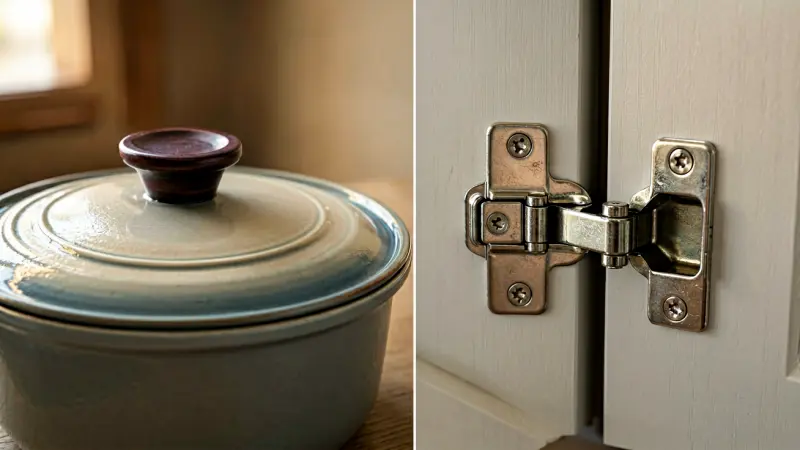
What Actually Makes a Door a Door
Doors are defined by more than the fact that they open and close. Several features tend to appear together, and their combination is what makes something read as a door rather than as something else.
Passage Rather Than Containment
A door controls movement between two spaces. You pass through a door to get from one side to the other. The space on each side is usually a room, a building, a vehicle cabin, or an outdoor area.
A lid controls access to the inside of a container. You do not walk through a lid. You remove it or lift it to reach what is inside, and then you put it back. The difference is between crossing a threshold and uncovering contents.
Scale Relative to a Person
Doors are usually sized for a human body. They are tall enough to walk through, wide enough to carry something through, and mounted at a height that makes passage natural. This is not a strict rule, since cabinet doors and pet doors exist, but it shapes the default mental image.
Lids are sized for the container they cover. A pot lid is roughly the width of the pot. A jar lid fits in one hand. The object’s size is set by what it seals, not by what passes through it.
Hinges, Tracks, and Handles
Doors commonly hang on hinges, slide along a track, or rotate on a pivot. They often have handles designed for pulling or pushing from a standing position. Lids may also hinge, but they are just as likely to lift straight off, screw on, or rest on top by their own weight.
The motion alone does not settle anything. A hinged lid still tends to be called a lid. The hinge is a hint, not a definition.
What Sits on the Other Side
Doors separate inside from outside, public from private, one room from another. The space behind a door is usually somewhere you can be. The space under a lid is usually somewhere things are stored, cooked, or sealed.
That distinction between a place and a contents-holder does a lot of quiet work. It explains why a walk-in freezer door is a door even when it looks like a heavy panel, and why a hinged trunk lid is a lid even though it swings upward on hinges.
What Makes a Lid a Lid
Lids are defined by closure and containment. They sit on top of an opening, seal it, and are removed when you need access. Most lids are not meant to be passed through, and most are not expected to bear the weight of a person.
There is also an expectation of rest. A lid typically rests on the rim of its container or sits flush against an opening. A door typically hangs from a frame and holds its own weight through its hardware.
Lids also tend to be defined by fit. A lid that does not seal properly is a bad lid. A door that does not seal properly is still a door, just a draughty one. That difference in what counts as failure reveals how differently the two categories are built.
Where the Line Genuinely Blurs
Several everyday objects sit in the grey zone, and this is where most arguments about lids and doors actually happen.
Car Hoods and Trunk Lids
A car’s trunk has a lid. Nearly everyone calls it that, and it opens upward on hinges to reveal a storage space. A car’s hood covers the engine bay and also opens upward on hinges. It is usually called a hood, but its behaviour is lid-like.
Meanwhile, the doors on a car are doors because you pass through them to enter the cabin. The naming follows function rather than mechanics. Two panels that move almost identically get different names because one admits a person and the other covers a compartment.
Toilet Lids and Seats
The toilet has a lid, and it is universally called that. It closes over a bowl and is lifted to use the fixture. The same object family also includes a seat, which is a separate hinged piece.
Notice that nobody calls the toilet lid a door, even though it does control access to a space of sorts. The space is not somewhere you go. It is somewhere waste goes. The category follows the nature of what lies beneath.
Coffin Lids
Coffins and caskets have lids, and the lid is sometimes hinged. The language is consistently lid-based, and the reason is scale and purpose. The object below is a container, and the panel seals it.
If you tried calling a coffin lid a door, the phrase would sound like a metaphor rather than a description. That reaction tells you something about how strongly the category is tied to containment rather than to movement.
Laptop Lids and Keyboard Covers
A laptop lid closes over the keyboard and screen. It hinges open and shut, it protects what is inside, and it is not something you pass through. The name is stable and no one argues about it.
Compare that with a cupboard door, which is roughly the same size and also hinges open. The cupboard door gives access to a space. The laptop lid covers a surface. Same motion, different category.
Hatchbacks, Hatches, and Cargo Doors
Aircraft and vehicles complicate things further. A hatch on a boat or a plane is often a heavy panel you lift or swing, and some hatches are large enough to walk through. Language tends to favour whichever term the industry settled on rather than a strict rule.
That is a useful lesson. When categories overlap, convention often decides the winner, and convention is not always logical. It is simply the name that stuck.
What Linguists and Philosophers Notice
The lid-versus-door question is a small version of a much older problem in philosophy and linguistics: how do words get their boundaries?
Family Resemblance
Ludwig Wittgenstein argued in his later work that many concepts do not have a single defining feature. Instead, they are held together by overlapping similarities, like members of a family who share some traits but not all. He used the example of games to make the point.
Lids and doors fit this model reasonably well. There is no single feature that all doors share and all lids lack. Instead, there is a cluster of tendencies, and most objects land clearly on one side or the other because they share several of them at once.
Prototype Theory
The psychologist Eleanor Rosch developed a related idea in the 1970s. She proposed that people categorise objects by comparing them to a mental “best example” rather than by checking a list of required conditions.
Most English speakers have a prototype for door: a rectangular wooden panel with a handle, mounted in a wall, large enough to walk through. A pot lid does not resemble that prototype closely, so it feels like a poor fit for the word. A cabinet door resembles it partially, so people accept it with a small mental shrug.
Why the Argument Feels Unresolvable
Both sides of a lid-versus-door debate are usually working from different prototypes. One person is thinking of a front door. The other is thinking of a hatch. Neither is wrong about the features they are naming. They are disagreeing about which features matter most.
Recognising that can defuse the argument. The question is not “what is the true definition” but “which features are we treating as decisive, and why.”
| Object | Controls Passage or Covers Contents | Typical Motion | What Lies Behind It | Common Verdict |
|---|---|---|---|---|
| Front door | Passage | Hinged, swinging | A room or building interior | Door |
| Cabinet door | Access to stored items | Hinged or sliding | A small enclosed space | Door |
| Car door | Passage for a person | Hinged, swinging outward | A passenger cabin | Door |
| Trunk lid | Covers contents | Hinged, lifting upward | A storage compartment | Lid |
| Pot lid | Covers contents | Lifted off or hinged | Food being cooked | Lid |
| Toilet lid | Covers an opening | Hinged, lifting upward | A bowl | Lid |
| Laptop lid | Covers a surface | Hinged, closing flat | A screen and keyboard | Lid |
| Boat hatch | Passage or access | Sliding or lifting | A compartment or cabin | Depends on size and use |
Does Any of This Actually Matter?
In casual conversation, the distinction is mostly a curiosity. In some contexts, it has real consequences.
Building codes and safety regulations often define specific terms precisely, and whether a panel counts as a door can determine what hardware, clearances, and fire ratings are required. Product manuals do something similar, using their own definitions so that instructions are unambiguous.
Insurance policies and legal documents also rely on defined terms. A claim about a damaged “door” may be assessed differently than a claim about a damaged “lid” or “cover,” depending on how the policy was written. Nobody drafting those documents is trying to settle a philosophical question. They are trying to remove ambiguity, and that requires picking one definition and sticking to it.
There is a broader point buried here. Definitions are not just descriptions of the world. They are tools people use to get things done, and the right definition depends on the job at hand. That is true for doors and lids, and it is true for far more consequential categories too, including the very personal question of what it actually means to feel rich.
How to Settle the Argument With Someone
If you find yourself in this debate, the fastest route out is to name the criterion before arguing about the answer.
Ask whether you are going by function, by form, or by convention. If you go by function, the deciding question is whether a person passes through it. If you go by form, the deciding question is how it moves and what it is attached to. If you go by convention, the deciding question is simply what people call it.
Most disagreements collapse once both people agree on which of those three they are using. A pot lid fails the function test, barely passes the form test, and fails the convention test. That is why almost everyone agrees it is not a door.
A car trunk lid is the opposite case. It passes the form test, fails the function test, and fails the convention test. Three out of three push it toward “lid,” which is why the name feels settled even though the mechanics look door-like.
Why People Ask This Kind of Question at All
Questions like this tend to surface during quiet moments, when the mind is idle and looking for something to chew on. They sit alongside other odd everyday puzzles, such as whether an ordinary bathroom habit could ever trigger a fire alarm. Both come from the same instinct: noticing that something ordinary does not quite fit the categories we use without thinking.
That instinct is worth keeping. It is the same one that leads people to question assumptions about work, money, habits, and how they spend their time. Reading widely helps sharpen it, and if you want somewhere to start, these books that support personal growth and clearer thinking cover a lot of ground without requiring a philosophy degree.
Frequently Asked Questions
Is a lid technically a door?
Not in standard English usage. A lid covers a container, while a door controls passage through an opening. The words overlap in some cases, but the default categories are distinct.
Is a car trunk lid a door?
No. It is consistently called a lid because it covers a storage compartment rather than admitting a person. The fact that it hinges upward is a similarity in mechanics, not a change in category.
What about a cabinet door?
A cabinet door is called a door because it gives access to a defined space you reach into. It is a marginal case, but convention firmly places it on the door side.
Is a hatch a door or a lid?
It depends on size and purpose. A small hatch covering a compartment reads as a lid. A large hatch you can walk through reads as a door. Industry terminology often settles it before general usage does.
Why do people disagree about this?
Because they are using different criteria. One person is judging by how an object moves, another by what it is used for, and another by what it is normally called. Once the criterion is agreed on, the disagreement usually resolves.
Does any language treat lids and doors as the same word?
Some languages use a single term for both, or use closely related words that overlap more than English does. Vocabulary boundaries vary between languages, which is part of why translation can be tricky for everyday objects.
The Practical Takeaway
A lid is not generally considered a door, and the reason is function rather than shape. Doors let people pass. Lids cover what is stored, cooked, or sealed. When an object seems to sit between the two, the deciding factor is usually what lies on the other side and whether anyone goes there.
The next time the question comes up, skip the insistence and name the criterion instead. Arguing about which features matter is far more productive than arguing about the label, and it tends to end the debate with everyone still speaking to each other.