It sounds like a joke you would hear in a school hallway, but the question comes up more often than you might expect. Someone walks out of a bathroom, the fire alarm in the hallway goes off, and the immediate assumption is that the two events are connected. The internet has turned this into a running gag, complete with dramatic reenactments and exaggerated claims about “toxic” bathroom visits.
The real answer is more interesting than the joke. Fire alarms respond to specific physical and chemical conditions, and understanding what those are tells you exactly how likely it is that a bathroom visit could trigger one. This article breaks down how different types of alarms work, what actually sets them off, and the rare situations where a bathroom could plausibly be involved.
The Short Answer
In normal circumstances, no. A standard fire alarm cannot detect poop, and the odour of human waste does not contain the particles or gases that these devices are designed to sense. The smell is caused by trace amounts of volatile sulfur compounds and other organic molecules, but these are not present at concentrations that any consumer fire alarm would register.
The situations where a bathroom could trigger an alarm are almost always about something else: steam, aerosol spray, dust, or an actual fire. The bathroom is a coincidence in those cases, not the cause.
How Fire Alarms Actually Work
Most residential and commercial fire alarms use one of two detection technologies, and each responds to different things.
Ionisation Alarms
Ionisation smoke alarms contain a tiny amount of radioactive material that ionises the air inside a chamber, creating a small electric current. When smoke particles enter the chamber, they disrupt that current, and the alarm sounds.
These alarms are particularly responsive to fast-flaming fires, which produce small, invisible particles. They are also prone to false alarms from cooking fumes, dust, and steam. Crucially, they respond to particles, not to odours or gases. If a substance does not produce airborne particles of the right size, the alarm will not react to it.
Photoelectric Alarms
Photoelectric alarms use a light source and a sensor. When smoke enters the chamber, it scatters the light, and the sensor detects the change. These alarms are better at detecting smouldering fires, which produce larger, visible smoke particles.
Like ionisation alarms, photoelectric devices respond to particles. Steam can trigger them, which is why bathrooms and kitchens are common locations for nuisance alarms. Odours alone will not.
Heat Detectors
Heat detectors respond to a rapid rise in temperature or to temperatures exceeding a fixed threshold. They do not respond to smoke, steam, or odours at all. These are often used in kitchens and utility rooms where smoke alarms would cause too many false alarms.
Carbon Monoxide and Combination Alarms
Carbon monoxide alarms detect the presence of CO gas, which is odourless and produced by incomplete combustion. Combination alarms may include smoke, heat, and CO detection in a single unit. None of these sensors respond to the compounds responsible for bathroom odours.
| Alarm Type | What It Detects | Can Bathroom Odours Trigger It? | Common False Alarm Causes |
|---|---|---|---|
| Ionisation smoke alarm | Small smoke particles from fast-flaming fires | No | Cooking fumes, dust, steam |
| Photoelectric smoke alarm | Larger particles from smouldering fires | No | Steam, shower mist, aerosol spray |
| Heat detector | Rapid temperature rise or high fixed temperature | No | Space heaters, direct sunlight, cooking |
| Carbon monoxide alarm | CO gas from incomplete combustion | No | Faulty appliances, blocked flues, car exhaust |
| Combination alarm | Multiple hazards depending on model | No | Depends on the sensors included |
What Actually Triggers a False Alarm in a Bathroom
Bathrooms are a common location for nuisance alarms, but the culprit is almost never what people assume.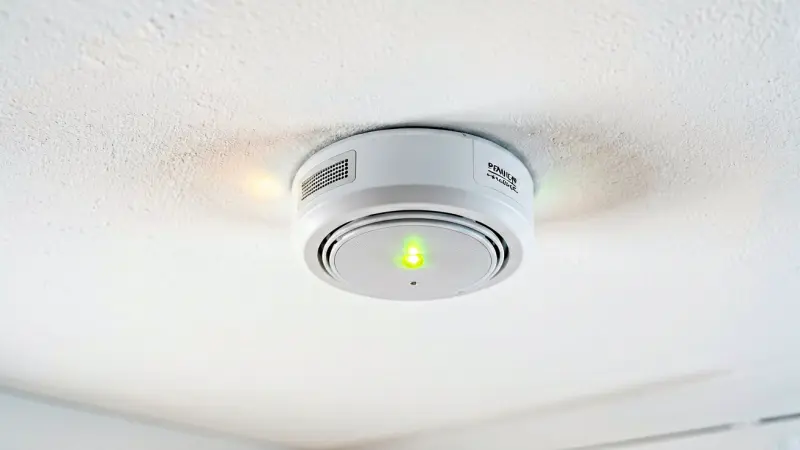
Steam From Hot Showers
Hot showers produce large amounts of water vapour. When that vapour reaches a photoelectric or ionisation alarm, it can mimic the effect of smoke particles and trigger the sensor. This is the single most common reason a bathroom alarm goes off.
The fix is straightforward. Run the exhaust fan during and after showers, keep the bathroom door open when possible, and avoid mounting smoke alarms directly above or beside the shower. Some building codes already require heat detectors rather than smoke alarms in bathrooms for exactly this reason.
Aerosol Products
Hairspray, deodorant spray, air freshener, and dry shampoo all release fine particles into the air. These particles can be detected by smoke alarms, particularly ionisation models. A heavy application in a small, poorly ventilated bathroom can trigger an alarm.
This is not a malfunction. The alarm is doing exactly what it was designed to do. The particles from an aerosol spray are physically similar to some combustion particles.
Dust and Debris
Dust accumulation inside the alarm chamber is a common cause of false alarms. Renovation work, dusty air from vents, and even a build-up of lint over time can all cause problems. Regular cleaning with a vacuum brush attachment helps prevent this.
Insects
Small insects can crawl into the sensing chamber of a smoke alarm and trigger it. This is more common in warm months and in areas with high insect activity. If an alarm goes off repeatedly without an obvious cause, an insect inside the unit is worth checking.
Actual Fires
This should be obvious, but it is worth stating. If a fire alarm goes off in or near a bathroom, there may be an actual fire. Electrical faults in exhaust fans, overheated hair appliances, and unattended candles are all real risks. Treat every alarm as genuine until you have confirmed otherwise.
Why Poop Itself Does Not Trigger Alarms
The smell of human waste is caused by a mixture of volatile organic compounds, including hydrogen sulfide, methyl mercaptan, and various indoles and skatoles. These compounds are detectable by the human nose at extremely low concentrations, which is why the smell is so noticeable.
Fire alarms, however, are not designed to detect these compounds. They detect particles or specific gases like carbon monoxide. The concentration of sulfur compounds in a bathroom after normal use is far too low to register on any consumer-grade alarm sensor.
There is also no combustion involved. The compounds are released through biological processes at body temperature, not through burning. Fire alarms are tuned to the byproducts of combustion, and those byproducts are simply not present in this situation.
The Scientific Principle Behind Smoke Detection
Understanding why smoke alarms respond to some things and not others comes down to particle size and optical or electrical properties.
Smoke from a fire contains a mixture of solid particles, liquid droplets, and gases. The particles vary in size, and different detection technologies are optimised for different ranges. Ionisation alarms respond best to particles in the 0.01 to 0.3 micron range. Photoelectric alarms respond better to particles in the 0.3 to 10 micron range.
Steam droplets and aerosol particles fall into these ranges, which is why they cause false alarms. The volatile compounds responsible for bathroom odours are individual molecules, far smaller than the particles these sensors are designed to detect. They simply pass through the sensing chamber without triggering a response.
This is the same reason that a scented candle can make a room smell strongly without setting off a smoke alarm, while blowing out a match can trigger one. The scent molecules are too small and too diffuse. The match produces actual combustion particles.
What About Methane and Other Gases?
Some people wonder whether the gases produced by digestion, particularly methane, could trigger an alarm. Methane is flammable, and in high concentrations, it can be explosive. This raises a reasonable question about whether a bathroom could ever become a hazard.
The answer is no, for practical purposes. The volume of methane produced by normal human digestion is tiny, measured in millilitres rather than litres. Bathrooms are not sealed chambers. Ventilation, even passive airflow, disperses the gas immediately. There is no realistic scenario in which a single person using a bathroom produces enough methane to reach flammable concentrations.
Methane alarms do exist for industrial settings, but they are not part of standard residential fire safety equipment. A home fire alarm would not respond to methane at all.
The Role of Ventilation and Bathroom Design
Bathroom design has a significant effect on how often alarms go off. Older bathrooms with poor ventilation are more prone to steam-related false alarms. Modern bathrooms with properly sized exhaust fans and adequate airflow are far less likely to cause problems.
Building codes in many jurisdictions recognise this. They often specify that smoke alarms should be installed outside bathrooms rather than inside them, or that heat detectors should be used instead of smoke detectors in bathroom areas. This is a deliberate design choice to reduce nuisance alarms.
If you are dealing with frequent false alarms in or near a bathroom, the fix is usually about airflow and placement rather than about the alarm itself. Improving ventilation, repositioning the alarm, or switching to a heat detector can resolve the issue.
How to Reduce False Alarms in Your Home
If you are tired of nuisance alarms, a few practical steps can help.
Clean your alarms regularly. Dust and debris build up over time and can cause sensitivity issues. Vacuum the exterior vents and follow the manufacturer’s instructions for deeper cleaning.
Check the placement. Avoid mounting smoke alarms directly above stoves, showers, or space heaters. The manufacturer’s instructions typically specify minimum distances from these sources.
Use the right alarm for the right location. Photoelectric alarms are generally better for areas near kitchens and bathrooms because they are less prone to certain types of false alarms. Combination alarms offer flexibility but may still be sensitive to steam and aerosols.
Replace alarms according to the manufacturer’s recommended schedule. Sensors degrade over time, and an old alarm may become either less reliable or more prone to false triggers.
This kind of attention to household systems is part of maintaining a living space that works smoothly. If you enjoy thinking through small home improvements, the same mindset applies to how you organise your day, whether that is a deliberate morning ritual built around what you actually enjoy or something as simple as doing everyday things on your own terms.
When to Take an Alarm Seriously
False alarms are annoying, and it is tempting to assume that any alarm in a bathroom is a malfunction. That assumption can be dangerous.
Every alarm should be treated as genuine until you have confirmed that there is no fire. Check for smoke, heat, and the smell of burning. If the alarm goes off repeatedly without an obvious cause, investigate rather than disabling the device.
Nuisance alarms are a signal that something about the environment or the equipment needs attention. Ignoring them, removing batteries, or covering the device defeats the entire purpose of having it.
If you are travelling and staying in unfamiliar accommodation, the same principles apply. Knowing what triggers alarms and how to respond is part of being a responsible guest, whether you are in a hotel or a rental property. Families travelling together have additional considerations, and resources like these eco-friendly travel tips for families often include practical advice about accommodation safety alongside environmental concerns.
Frequently Asked Questions
Can the smell of poop set off a smoke alarm?
No. Smoke alarms respond to particles produced by combustion, not to odour molecules. The compounds responsible for bathroom odours are too small and too diffuse to trigger any standard consumer alarm sensor.
What about methane from digestion?
The amount of methane produced by normal human digestion is far too small to reach flammable concentrations in a ventilated bathroom. Standard home alarms do not detect methane anyway. Industrial methane detectors exist but are not part of typical residential fire safety equipment.
Why does my bathroom alarm go off when I shower?
Steam from hot showers is the most common cause. Water vapour can mimic the effect of smoke particles in photoelectric and ionisation alarms. Improving ventilation or relocating the alarm usually solves the problem.
Can air freshener set off a fire alarm?
Yes. Aerosol air fresheners, hairspray, and deodorant sprays release fine particles that smoke alarms can detect. Heavy use in a small, poorly ventilated space is a common cause of false alarms.
Should I put a smoke alarm in my bathroom?
Building codes in many places advise against installing smoke alarms inside bathrooms. Heat detectors are a better option for bathroom areas because they respond to temperature changes rather than particles. Check your local requirements and the manufacturer’s guidance.
What should I do if my alarm keeps going off for no reason?
Clean the alarm, check for insects or dust inside the chamber, and review its placement. If the problem continues, the unit may need replacement. Do not disable it. Investigate every alarm until you are certain there is no fire risk.
What to Remember
Poop cannot set off a fire alarm. The sensors inside smoke detectors are tuned to combustion particles and specific gases, not to the volatile compounds that create bathroom odours. The scenarios where a bathroom visit coincides with an alarm are almost always about steam, aerosol spray, dust, or an actual fire elsewhere.
If you are dealing with frequent false alarms, focus on ventilation, placement, and regular cleaning. Those are the factors that actually influence how often an alarm sounds. And if an alarm goes off, treat it as real until you have confirmed otherwise. That habit is what keeps the device useful.