Flaring your nostrils on command is a niche skill that fascinates people who want to add a subtle expression to their acting repertoire or simply win a personal challenge. The movement looks simple, yet many people discover that their nostrils refuse to obey. Understanding why this happens requires a look at the muscle responsible and the limits of voluntary facial control.
This guide explains the anatomy behind nostril flaring, why some people can do it easily while others struggle, and which techniques are most likely to help you gain control. It also covers common mistakes, variations like one-sided flaring, and the situations where nostril movement is not a choice at all.
The Anatomy Behind Nostril Flaring
Nostril flaring is driven primarily by the nasalis muscle, a thin sheet of muscle that covers the bridge and sides of the nose. The alar part of the nasalis attaches to the cartilage of the nostril and pulls it outward and upward when it contracts. This action widens the nasal opening, which is why the movement is often described as a flare.
The nasalis is a facial muscle, and like other muscles of facial expression, it is controlled by the facial nerve. Voluntary control over facial muscles varies widely between individuals. Some people can raise one eyebrow or wiggle their ears with ease, while others cannot isolate those movements at all. Nostril flaring sits on the same spectrum of isolated facial control.
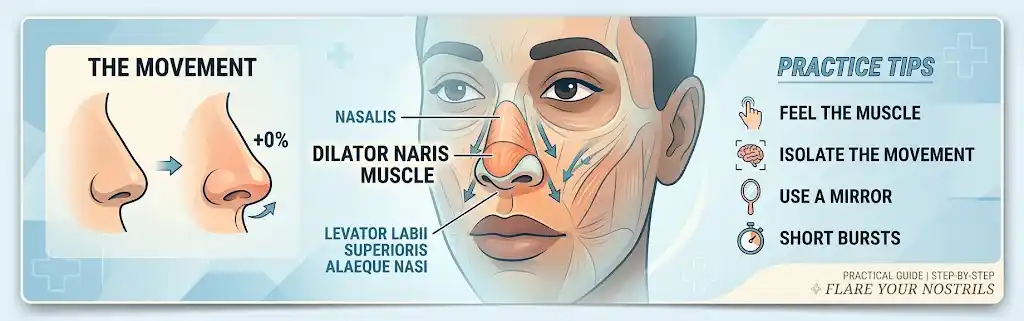
In everyday life, the nasalis often works without conscious thought. The nostrils widen slightly during a deep breath, a sharp sniff, or a moment of surprise. This involuntary action supports airflow when the body needs more air quickly. The challenge for most people is not activating the muscle but activating it on demand without triggering other facial movements.
Why Some People Can Flare on Command and Others Cannot
The ability to flare your nostrils on command depends on two factors: proprioception and isolated muscle control. Proprioception is your sense of where your body parts are and what they are doing. If you cannot feel your nasalis contracting, you will struggle to reproduce the movement deliberately.
Isolated muscle control is the capacity to move one muscle group without moving neighboring ones. Scrunching your whole nose, squinting, or grimacing are common signs that the wrong muscles are engaging. People who can flare cleanly have learned to separate the nasalis from the muscles that wrinkle the nose or raise the upper lip.
This ability is not fixed. Many people who cannot flare on their first attempt can develop the skill with practice and feedback. However, some individuals may never achieve a clean, isolated flare because of natural differences in facial muscle anatomy or nerve signaling. That outcome is normal and not a sign of a problem.
Step-by-Step Technique to Try
The following sequence is the most practical approach for most beginners. Work through each step slowly and stop if you feel any discomfort. Facial muscles tire quickly, so short practice sessions are more effective than long ones.
Step 1: Locate the Sensation
Start by taking a sharp sniff through your nose. You should feel a slight widening at the base of your nostrils. That widening is the nasalis working. Repeat the sniff a few times and pay close attention to the sensation. The goal is to recognize the feeling so you can reproduce it without the sniff.
Step 2: Use a Mirror for Biofeedback
Stand in front of a mirror and try to recreate the widening you felt during the sniff. Watch your nostrils closely. Many people are surprised to see that what feels like a flare looks like nothing at all, or that it comes with a scrunched nose. The mirror gives you honest feedback that your internal sense cannot provide.
Step 3: Isolate the Movement
Once you can produce some widening, focus on keeping the rest of your face still. Relax your forehead, keep your mouth closed but not tight, and avoid squinting. If your nose wrinkles, you are engaging the procerus or levator muscles instead of the nasalis. Try again with less effort. A gentle attempt often produces a cleaner flare than a forceful one.
Step 4: Practice with Visual Cues
Imagining a strong or unpleasant smell can trigger a reflexive nostril flare. Use that mental cue while watching yourself in the mirror. Over time, you can pair the cue with the physical sensation and gradually reduce your reliance on the cue. This is similar to how actors learn to access specific facial expressions on demand.
Step 5: Build Consistency with Short Repetitions
Practice for one or two minutes at a time, several times a day. Fatigue in facial muscles can make the movement sloppy and discourage you. Short, focused repetitions with rest in between tend to produce better results than marathon sessions. If you feel self-conscious practicing in public, remember that going to the mall alone is a normal activity, and practicing a facial movement is far less noticeable than you might think.
Common Mistakes and How to Fix Them
One of the most frequent mistakes is using too much force. A hard sniff or a exaggerated grimace may flare the nostrils, but it also recruits many other muscles. The result looks tense and is difficult to sustain. Reduce the effort and aim for a subtle, controlled movement instead.
Another common error is holding your breath. Breath-holding often accompanies concentration, but it creates tension in the face and neck. Breathe normally while practicing. If you notice yourself holding your breath, pause, exhale fully, and try again.
A third mistake is practicing only in front of a mirror. Mirrors are useful for feedback, but they can also make you dependent on visual confirmation. Once you can produce the movement with the mirror, try it without one. Close your eyes and rely on the sensation. This builds the internal awareness you need to flare on command in any situation.
Finally, many people give up too early. Facial muscle control develops slowly, and progress can be hard to see. If you cannot flare after a week of practice, that does not mean you will never learn. It may mean you need a different cue or more rest between attempts.
Voluntary vs Involuntary Nostril Flaring
Understanding the difference between voluntary and involuntary flaring helps you set realistic expectations and recognize when the movement is outside your control. The table below compares the two types across several practical dimensions.
| Feature | Voluntary Flaring | Involuntary Flaring |
|---|---|---|
| Trigger | Conscious effort or mental cue | Emotion, physical exertion, or breathing demand |
| Primary muscle | Nasalis (alar part), often with minimal involvement of other muscles | Nasalis along with other facial and respiratory muscles |
| Frequency in daily life | Rare, unless deliberately practiced | Common during exercise, surprise, anger, or strong smells |
| Ability to sustain | Limited; the muscle tires quickly | Brief, lasting only as long as the trigger |
| Ease of control | Varies widely between individuals | Not under conscious control |
Variations: Unilateral Flaring and Subtle Movements
Some people can flare only one nostril at a time, while others can flare both independently. Unilateral flaring is more difficult because it requires even finer isolation of the nasalis on one side. If you can flare both nostrils together, try shifting your focus to one side. The sensation is often described as a slight tug near the crease of the nose.
Subtle flaring is another variation worth exploring. Instead of a large, dramatic widening, aim for a barely perceptible movement. Actors often use this subtle version to convey disdain, curiosity, or suppressed emotion without exaggerating the face. The ability to control the intensity of the flare is more useful in performance than maximum width.
When Nostril Flaring Is Not Under Your Control
In some situations, nostril flaring is a sign that the body is working harder to breathe. Infants and young children may show nasal flaring when they are experiencing respiratory difficulty. In adults, noticeable flaring can occur during intense exercise, high fever, or respiratory infections. These are involuntary responses, not failed attempts at voluntary control.
If you or someone else experiences persistent nostril flaring along with shortness of breath, chest retractions, or a bluish tint around the lips, seek medical attention promptly. This guide is not a substitute for professional medical evaluation. The techniques described here are for voluntary facial control, not for managing breathing problems.
Frequently Asked Questions
Can everyone learn to flare their nostrils on command?
Not everyone can achieve a clean, isolated flare. Some people have natural limitations in facial muscle control or proprioception that make the movement difficult or impossible. However, many people can improve with consistent practice and the right feedback.
Does flaring your nostrils help you breathe better?
Nostril flaring can slightly reduce airflow resistance by widening the nasal opening. This effect is small and temporary. It is not a substitute for proper breathing techniques or medical treatment for nasal obstruction.
Is nostril flaring bad for you?
Voluntary nostril flaring is generally harmless when performed gently. Forcing the movement or practicing for long periods can cause facial muscle fatigue or discomfort. Stop if you feel pain or tension.
How long does it take to learn?
Some people learn within a few days, while others need weeks or months of practice. Progress depends on your starting level of facial muscle control and how consistently you practice. Short, daily sessions are more effective than occasional long ones.
Why can I flare my nostrils when I sniff but not on command?
The sniff triggers a reflexive activation of the nasalis, which bypasses the need for conscious control. Learning to flare on command means building a voluntary pathway to the same muscle. Mental cues and mirror feedback can help bridge that gap.
Conclusion
Flaring your nostrils on command is a learnable skill for many people, but it is not universal. The nasalis muscle responds to practice and feedback, yet individual differences in facial control mean that some people will find it easier than others. The most effective approach combines locating the sensation through sniffing, using a mirror for honest feedback, and practicing short, gentle repetitions without tensing the rest of your face.
If progress is slow, adjust your technique rather than forcing the movement. Subtle control is more valuable than a dramatic flare, especially if you want to use the expression in acting or social situations. And if you notice involuntary flaring that comes with breathing difficulty, treat it as a signal to seek medical advice rather than a skill to practice.