A circle that shrinks before your eyes can be genuinely unsettling. You may be watching a shape on a screen, looking at a ball across a room, or studying a diagram that seems to change size as you stare at it. In some cases the circle is not changing at all, and your visual system is doing the work. In others, something physical or digital really is making it smaller.
This article separates those possibilities so you can figure out which one applies to your situation. It covers distance and perspective, the classic optical illusions that shrink circles, the physical reasons a round object loses size, and the digital and vision-related causes that often get mistaken for one another.
The Short Answer: Distance Changes How Big a Circle Looks
The most common reason a circle appears to get smaller is that it is moving farther away from you. A ball rolled across a field does not physically shrink, but it occupies less of your field of view as the distance grows. Your brain interprets that reduced image size as greater distance rather than a smaller object.
This is not a flaw in your eyes. It is how human vision works. Your eyes receive a flat image on the retina, and your brain reconstructs depth from cues like size, overlap, and the convergence of your eyes. Size is one of the strongest cues available, which is why a shrinking circle reads as receding.
You can test this with a coin. Hold it close to your face, then slowly extend your arm. The coin does not change, but the image it casts on your retina gets smaller. Nothing about the coin shrank. Only the angle it subtends from your eye changed.
Visual Angle: The Measurement Behind the Effect
Optics uses a concept called visual angle to describe how much of your view an object occupies. A circle held at arm’s length creates a wider visual angle than the same circle held at the far end of a room. As the visual angle narrows, the circle covers less of your retina.
Your brain learns to correct for this automatically. When you see a familiar object at a distance, you perceive it as roughly the same size rather than as a tiny version of itself. This correction is called size constancy, and it usually works well.
Size constancy breaks down when the brain lacks reliable distance cues. A circle in an empty white space with no background reference has nothing to anchor its distance. Without that context, the raw retinal image takes over, and the circle can seem to change size as you shift your attention.

Optical Illusions That Make Circles Look Smaller
Several well-documented illusions cause circles of identical size to appear different. These are not tricks played by faulty eyes. They are the result of the brain comparing an object to whatever surrounds it.
The Ebbinghaus Illusion
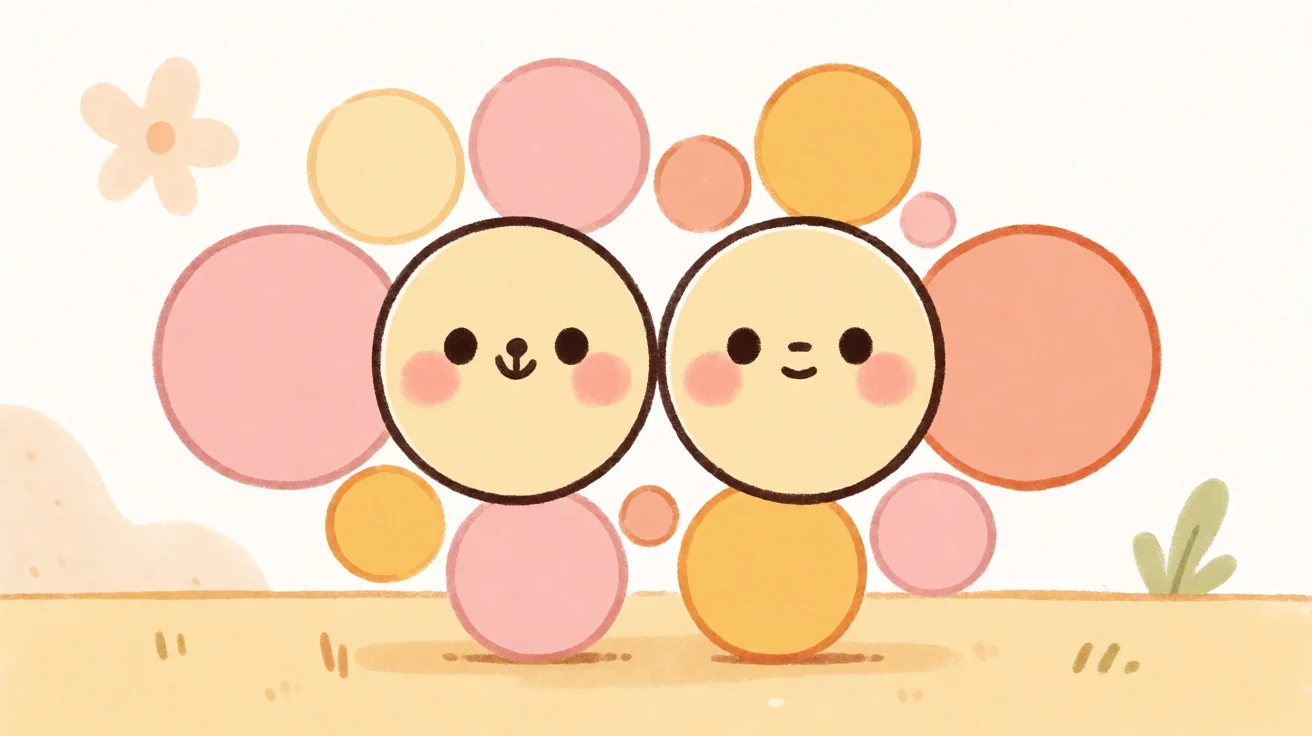
In the Ebbinghaus illusion, two identical circles sit side by side. One is surrounded by large circles. The other is surrounded by small circles. The circle surrounded by large shapes looks smaller, even though the two central circles are the same size.
The effect works because your visual system judges size relative to context rather than in absolute terms. Surrounded by giants, an average circle reads as small. Surrounded by tiny circles, the same circle reads as large. The illusion is strong enough that people often refuse to believe the two central circles are identical until they measure them.
The Delboeuf Illusion
The Delboeuf illusion places two identical circles inside larger rings of different sizes. The circle inside the tighter ring looks larger, while the circle inside the wider ring looks smaller. The distance between the inner circle and its surrounding ring is what drives the effect.
This illusion shows up in everyday life more often than people realize. Plate size, for example, can influence how much food looks like a reasonable portion. A small serving on a large plate can read as meager, while the same serving on a small plate looks generous.
The Ponzo Illusion
The Ponzo illusion uses converging lines that resemble a road or railway track receding into the distance. Two identical horizontal shapes placed between the lines appear different in size. The shape near the narrow end of the lines looks larger, and the shape near the wide end looks smaller.
The converging lines trick the brain into reading depth. Once depth is assumed, size constancy kicks in and adjusts the perceived size of each shape. A circle placed on this kind of background can appear to shrink as it moves toward the wide end, even though its pixel dimensions never change.
These illusions matter because they show that perceived size is not a direct readout of physical size. It is an interpretation, and that interpretation can be shifted by anything nearby. The same principle explains why a sudden movement in your peripheral vision, like a spider dropping from the ceiling, can feel larger and faster than it actually is.
When the Circle Is Physically Getting Smaller
Not every shrinking circle is an illusion. Sometimes the object genuinely loses size. Several physical processes can cause that, and the cause usually determines whether the change is permanent or reversible.
Thermal Contraction
Most solid materials expand when heated and contract when cooled. A metal ring, a plastic disc, or a rubber gasket will shrink measurably as its temperature drops. The change is usually small, but it can be noticeable on a precise measurement or on a large object.
This principle is used deliberately in manufacturing. A metal ring can be cooled until it shrinks enough to slide onto a shaft, then allowed to warm and expand into a tight fit. Engineers rely on thermal contraction because it produces a stronger joint than many alternatives.
Moisture Loss
Materials that contain water shrink as they dry. Clay, wood, fruit, and many foods lose volume as moisture evaporates. A round slice of fruit left in dry air will curl and reduce in diameter over time. Wood can develop cracks and lose dimension as it seasons.
Drying shrinkage is not uniform in every material. Wood shrinks differently along its grain than across it, which is why a round wooden disc can become slightly oval rather than a smaller perfect circle. Clay tends to shrink fairly evenly, which is why potters plan for a significant size reduction between the wet and fired stages.
Stretching, Wear, and Deformation
A circle can also appear to shrink because it is being pulled out of shape. A rubber band looped into a circle shrinks when stretched, since stretching reduces its cross-sectional width. A worn bearing or a flattened tire loses diameter through deformation rather than uniform contraction.
In these cases the object is not shrinking so much as redistributing its material. The total amount of substance stays roughly the same while the visible circular outline narrows.
Digital Reasons a Circle Shrinks on a Screen
Screens introduce their own set of causes. A circle rendered on a display can appear to change size for reasons that have nothing to do with optics or physics.
Browser zoom, pinch gestures, and responsive design all change how large a shape is drawn. A circle defined in relative units will resize when the window resizes. A circle defined in fixed pixels will not, which can make it look inconsistent next to other elements.
Video and animation add motion blur, frame rate, and easing curves. A circle animated with an ease-out curve decelerates as it shrinks, which can make the change feel slower or faster than it really is. Compression artifacts in low-quality video can also distort edges and make a shape appear to pulse.
Camera lenses matter as well. Wide-angle lenses produce barrel distortion, which bows straight lines outward near the edges of the frame. A circle photographed near the edge of a wide-angle shot can appear stretched rather than shrunken. Telephoto compression does the opposite, pulling distant objects forward and flattening depth.
The table below summarizes the main causes covered so far and how to tell them apart.
| Cause | Is the circle really changing? | How to check |
|---|---|---|
| Increased distance | No, only the visual angle changes | Measure the object itself, not the image on your retina |
| Ebbinghaus or Delboeuf illusion | No, surrounding shapes create the effect | Cover the surrounding shapes and compare again |
| Ponzo illusion | No, converging lines imply false depth | Remove the background lines and re-check |
| Cooling | Yes, physically smaller | Measure before and after at different temperatures |
| Drying or moisture loss | Yes, physically smaller | Weigh the object; mass loss usually accompanies shrinkage |
| Stretching or deformation | Shape changes, volume stays similar | Look for oval distortion rather than uniform reduction |
| Screen zoom or responsive layout | Only the rendering changes | Check the code or zoom level |
| Lens distortion | Only the image changes | Compare with a different lens or a longer focal length |
Vision-Related Reasons a Circle Appears to Shrink
Sometimes the circle is unchanged, the surroundings are unchanged, and the shift is happening inside your own visual system. Several normal eye processes can make a stationary circle seem to shrink.
Pupil Size and Light Level
Your pupil widens in dim light and narrows in bright light. This changes how much light reaches the retina and can subtly alter how sharp and how large a shape appears. Bright light typically sharpens edges, which can make a shape look more defined and slightly smaller because its boundaries are clearer.
Accommodation and Focusing
The lens inside your eye changes shape to focus on objects at different distances. When you shift focus from something near to something far, the lens flattens. This adjustment is called accommodation, and it can produce a brief sensation that a shape is shifting size.
People with presbyopia, a common age-related change in lens flexibility, often notice that near objects seem to shrink or grow as they struggle to focus. The circle is not moving. The focusing system is hunting for a clear image.
Attention and Staring
Staring at a single point for a long time can cause the image to fade or appear to move. This is called the Troxler effect, and it happens because your visual system stops responding to unchanging input. A circle stared at long enough can seem to pulse, drift, or subtly change size.
The effect reverses the moment you move your eyes. That is one reason the recommended technique for breaking the illusion is to blink, look away, or shift your gaze to a different part of the image.
Why the Moon and Other Distant Circles Seem to Change Size
The moon is a circle that famously appears larger near the horizon than high in the sky. The moon itself does not change size during the night, and its distance from Earth varies only slightly over its orbit. The difference is in how your brain interprets the scene.
When the moon sits low on the horizon, buildings, trees, and hills provide depth cues that make it seem farther away. Your brain compensates by perceiving it as larger. When the moon is high in an empty sky, those cues vanish and it reads as smaller.
Photographs confirm that the moon’s actual angular size barely changes between the two positions. The horizon moon illusion is a perception effect, not an astronomical one. The same reasoning applies to any circle viewed against a background that suggests depth.
Everyday Situations Where Circles Seem to Shrink
Understanding these causes helps in practical situations. A driver watching a distant round sign may misjudge its size because of perspective. A photographer composing a shot may not realize the lens is distorting a circular subject near the frame edge.
A cook watching a ball of dough rest may be seeing genuine shrinkage from gluten relaxation rather than an illusion. A potter planning a bowl has to account for the clay shrinking during firing, or the finished piece will be noticeably smaller than intended.
Even small personal judgments are affected by context. How large a portion looks, how far away a goal feels, and how much progress counts as meaningful all depend on the reference points around them. That tendency to measure things against their surroundings rather than in absolute terms shows up in how people assess their own lives, including the gap between what they have and what they wish they had.
Perception also shifts with familiarity. A shape you see every day stops drawing attention, while a new one stands out. The same process happens with people and places. A situation that once felt unfamiliar can become comfortable so gradually that you barely notice the change, which is part of how a single moment can reshape what you assumed about yourself.
Frequently Asked Questions
Why does a circle look smaller when I move it away from my face?
Because it occupies a smaller visual angle. The circle itself does not change, but the image it projects onto your retina gets smaller as the distance increases. Your brain usually corrects for this using size constancy, but the raw image really does shrink.
Is the Ebbinghaus illusion the same as a circle actually shrinking?
No. In the Ebbinghaus illusion, the central circles are identical in size. Only the surrounding shapes differ, and those surroundings change how your brain judges the center. Covering the surrounding circles removes the effect.
Can a metal circle really shrink at room temperature?
Yes, but only slightly. Most metals contract as they cool and expand as they warm. The change is small enough that you would need precise measurement to detect it at normal room temperatures. Larger temperature swings produce larger changes.
Why does a circle seem to shrink when I stare at it?
Prolonged staring can trigger the Troxler effect, where your visual system stops responding to unchanging input. The shape may appear to fade, drift, or change size. Blinking or shifting your gaze usually resets it immediately.
Does camera lens distortion make circles smaller?
Lens distortion usually stretches or bows shapes rather than uniformly shrinking them. Barrel distortion pushes edges outward, which can make a circular subject near the frame edge look larger or egg-shaped. Telephoto compression changes perceived depth rather than size.
Is there a way to tell whether a circle is truly shrinking?
Measure it. Use a ruler, calipers, or a fixed reference object in the same frame. If the measurement stays the same while your perception changes, the effect is in your visual system or in the surrounding context, not in the object.
The Practical Takeaway
A circle gets smaller for two very different sets of reasons, and telling them apart is the key to solving the puzzle. If the circle is moving away, surrounded by misleading shapes, or sitting in a scene with false depth cues, the change is perceptual. Your eyes and brain are doing their normal job, and the circle is exactly the size it was before.
If the measurement itself changes, something physical is happening. Cooling, drying, stretching, or deformation are the usual suspects, and each leaves different evidence behind. Checking the measurement is always the fastest way to settle the question. Once you know whether the size changed or only the perception changed, the rest of the explanation falls into place.